Jannatul Baqi Map

Jannatul Baqi Map
Jannatul Baqi Map

Monday, 3 June 2013

Analysis of the tradition from Sahih Muslim

HADITH OF ABU AL-HAYYAJ
Now it is the time to closely examine the hadith which the Wahhabi scholars narrate. Here we produce a tradition from Sahih Muslim:
             

Narrated to us Yahya bin Yahya, Abu Bakr bin Abi Shayba and Zuhayr bin Harb (on the authority of) Waki’ who narrates from Sufyan who narrates from Habib bin Abi Thabit who narrates from Abu Wa’il who narrates from Abu al-Hayyaj that ‘Ali told him: “I assign you for a task which the Holy Prophet (s) assigned me for the same. Do not leave any picture but that which you erase nor any high grave but that you level it.” [1]

The Wahhabis have utilized this tradition as a pretext without paying attention to the authenticity and logic of the tradition.

Our Views about this Tradition

Whenever we wish to derive an Islamic ruling from a hadith, it should possess two conditions:


1. The authenticity of tradition should be correct; that is to say, the narrators of tradition should be such people that one could rely on their sayings.


2. The instruction of tradition should be clear upon the purpose.

That is to say the words and the sentences of the tradition should clearly prove our purpose such that if we give the same tradition to a person well versed in language and aware of its specifications, he would be able to derive the same meaning as we derive.

Unfortunately, this tradition is worthy of criticism from both these points especially the second, where one can find no relation with its purpose.

From the viewpoint of authenticity (isnad), the traditionalists (those expert in the science of hadith) do not accept the reliability of the persons narrating this tradition because we see that its narrators are people like (1) Waki’ (2) Sufyan al-Thawri (3) Habib bin Abi Thabit and (4) Abu Wa’il al-‘Asadi. 

A traditionalist such as Hafiz Ibn Hajar al-’Asqalani has criticised them in his book Tahdhib al-tahdhib to such an extent that it throws doubt and uncertainty on the authenticity of the aforementioned tradition and other traditions narrated by them.

1. For example he narrates from Ahmad bin Hanbal about Waki’ that:
“He has committed mistakes in 500 traditions.” [2]                                                                                                             

He also narrates from Muhammad ibn Nasr al-Marwazi about Waki’ that:
        
                                                                                  
 “He used to narrate the tradition according to its meaning (rather than narrating the precise text) while his mother-tongue was not Arabic”. [3]

2. About Sufyan al-Thawri, he narrates from Ibn al-Mubarak that:  


“Sufyan was narrating a tradition when I suddenly arrived and noticed that he was deceiving in tradition. When he saw me, he felt ashamed.” [4]

Deception in any tradition in whatever meaning it may be interpreted shows that there had been no equity, truthfulness and realism in such a man that he has presented the untrue things to be true.

In the translation of Yahya al-Qattan, he narrates from him that Sufyan tried to present to me an unreliable person to be reliable but eventually he was unsuccessful. [5]

3. About Habib ibn Abi Thabit, he narrates from Ibn Hibban that:
                                                                                                                                            
“He was deceiving in tradition.”

He also narrates from al-Qattan that:


“His traditions cannot be followed because they are not firm.”[6]

4. About Abi Wa’il he says:

“He is from the nawasib and from the deviators from (the path) of ‘Ali (‘a) [7]

It is worthy of attention that in the entire sihah sitta only one tradition is narrated from Abu al-Hayyaj and that is the same which we have discussed already. It shows that a person, whose share from the Prophetic knowledge was only one tradition, was not a man of tradition at all. Therefore, it becomes difficult to rely on him. When the reference of tradition possesses such shortcomings, then no jurisprudent (faqih) can pass a verdict (fatwa) based on such a weak reference.

The ‘instruction’ of tradition is no less important than its reference as the following words in this tradition testify:
                                                                                                                                                                                                                                                                                                
Now we will discuss the meaning of these two words i.e.
(a).  and
(b).

(a). The word in dictionary means high and elevated and it has been said that

      is a high place overlooking the other place.”   [8]

The author of al-Qamus who is having greater validity in the arrangement of meaning of words says:
                                                                                         

 with vowel of () is named as something ‘high’ and ‘the hump of a camel’.

Therefore the word () in absolute term is called as ‘height’ and in particular that height which is in the shape of a hump of a camel. By referring to the past, we have to see the objective pertains to which kind of height.

(b).The word  in dictionary means ‘to restore equilibrium’, ‘to make equal’ and ‘to set right the crooked’.


. He made it straight; Arab says - I wanted to set right the crooked which was not smoothened. It also comes in the meaning of ‘a faultless product’.

The Holy Qur’an says:
                                                                                                                                       

“Who creates, then makes complete”. (A’la: 2)

After knowing the meanings of phrases and words, we have to see what this tradition means!

Two possibilities exist in this tradition. We have to select one of the two by paying attention to the individual meanings and other logical possibilities, the first one of it is:

1. One possibility is that Prophet (s) ordered Abul-Haiyyaj to destroy the elevated graves and level them to the ground.

This possibility which the Wahhabis rely upon is rejected due to the following reasons:

Firstly, the word  does not mean ‘to destroy’ or ‘to demolish’ and if it meant so then they should have said:


Level them to the ground while we do not find such words in the tradition.

Secondly, if it is meant what they say then why the scholars of Islam have not given such a verdict (fatwa)? It is because leveling of grave to the ground is against the Islamic Sunnah which says that a grave should be slightly higher than the ground level and all the jurisprudents (fuqaha) of Islam have given verdict (fatwa) over this matter that a grave should be higher than the level of ground by one span.


In the book al-Fiqh ‘ala al-madhahib al-‘arba’a, as per the verdicts (fatawa) of the four well-known Imams (Hanifa, Malek, Shafe’i and Hanbal), we read as such:
                                                                                                                                                                                                                                                                                                                           

“It is recommended (mustahab) that the soil of grave be higher than the ground by one span.” [9]

By paying attention to this matter we are bound to interpret the tradition in some other way to which we shall now refer.

2. Second possibility is that he was ordered to make the top of the grave uniform, even or flat and not like the graves which are made in the shape of the hind of a fish or the hump of a camel.

Therefore, the tradition is a witness to this fact that the top of a grave should be even and flat and not in the shape of the hind of a fish or a hump which is common among some of the Ahl al-Sunnah. All the four well-known Imams of Ahl al-Sunnah, except al-Shafi’i, have given fatwa that the grave is recommended to be so. Thus this tradition conforms to the Shi’a scholars who say that a grave apart from being above the ground should be even and flat. [10]

Incidentally, Muslim, the author of Sahih has himself brought this tradition and another tradition which we shall soon discuss under the title     


and similarly al-Tirmidhi and al-Nasa’i have brought this tradition in their Sunan under the aforementioned title. This title gives the meaning that the surface of grave should be even and flat and if it meant that the graves should be made level to the ground then it was necessary to change the title and name it as  

Incidentally, in Arabic language if  is ascribed to any thing (like grave) it means that the thing itself should be flat and even and not that it should be made equal with any thing (like ground).


Here we produce another tradition which Muslim has narrated in his Sahih and this tradition too contains the same contents which we have approved.


The narrator says: We were with Fudala bin ‘Ubayd in Rome when one of our companions died. Fudala ordered that his grave be made uniform and said that he had heard the Holy Prophet (s) giving instructions for the leveling of graves. [11]

The key to understanding this tradition lies in acquiring the meaning of the word  which posseses three possible meanings. By paying attention to the legal presumptions one of them should be selected. Here are the three possibilities:

1. One meaning is ‘to destroy the structure over the graves!’ This possibility is false because the graves which were in Medina were not possessing structure or dome.
2. Another meaning is ‘to level the surface of the grave to the ground’. This is against the Sunnah (practice) of the Prophet (s) which is conclusive that the grave should be above the ground by one span.
3. Lastly it could mean ‘to surface the grave and make even the uneven portions and hence bring it out from the shape of hind of a fish or hump of a camel’. This meaning is exact and precise and needs no reason for proving this interpretation.

Now let us see how the famous commentator of Sahih Muslim, al-Nawawi, interprets the tradition. He says:


“It is Sunnah (tradition) that the grave should not possess excessive height above the ground and should not have a shape of a hump of a camel. However it should be one span above the ground and should be even.” [12]

This sentence shows that the commentator of Sahih Muslim has derived the same meaning as we have derived from the word . That is to say, Imam al-Nawawi recommended and advised that the surface of the graves should not possess the shape of the hind of a fish and they should be made uniform, flat and even, not that they should be levelled with the ground or that the grave and the structure on it should be destroyed.

It is not only we who have interpreted the tradition as such but al-Hafiz al-Qastallani too in his book Irshad al-sari fi sharh Sahih al-Bukhari has interpreted the tradition as we have. He says:

“It is the sunnah that a grave should be surfaced and we should never abandon this Sunnah just because surfacing of the grave is the motto of the rawafid. When we say that the Sunnah is surfacing of grave (having no difference with the tradition of Abu al-Hayyaj) it is because
                                                         
The objective is not to make the grave on par with the ground but the objective is to make the surface of the grave flat and even although being above the ground level. [13]

Moreover, if the objective of recommendation was to destroy the structures and domes over the graves then why didn't ‘Ali (‘a) himself destroy the domes over the graves of the Prophets existing during his own time!? Besides, he was the ruler over the Islamic lands and places like Palestine, Syria, Egypt, Iraq, Iran and Yemen, which were full of such structures over the graves of the Prophets and were within his sight.

Forgoing all that we have said even if we assume that Imam (‘a) ordered Abu al-Hayyaj to level all the elevated graves on par with the ground, still the tradition never bears testimony over the necessity of destroying the structures over the graves since Imam (‘a) has said:


i.e. ‘destroy the graves’, but has not said:
                           

‘There is no building and no dome (dome of grave) unless I made them separate’.

Moreover our discussion is not about grave itself but about construction and structures over the graves where people occupy themselves under the shade of these structures and recite the Qur’an, invocation and prayers. Which part of this sentence bears testimony for the destruction of the structures surrounding the graves which in fact facilitates the visitors to worship and recite Qur’an and protects them from extreme heat or cold!

Two more possibilities in tradition


In the end we are bound to present two more possibilities in the tradition:

(1) It is possible that this and some other similar traditions are pointing to a series of graves of the past people where people took the graves of the pious and virtuous people as their qibla instead of performing prayers towards the true qibla. They used to perform prayers over the grave and the picture which was near the grave and were refraining from facing the true qibla which God has selected.

Thus the tradition has no connection to the graves which have never been prostrated upon by the Muslims but have recited prayers near them facing the divine qibla (Ka’ba).

And if they expedite in visiting the graves of the pious people and worship God near their pure bodies and the holy graves, it is because of the high esteem these dignified places have acquired due to the burial of their bodies. We shall discuss about them later on.


(2) By  is meant the portrait of idols and by  is meant the graves of polytheists which were still respected by their near and far ones.

Over here we shall narrate the verdicts of the four scholars of Sunni school of thought:


It is makruh (abominable) to build a house, dome, school or mosque over the grave.” [14]


With such consensus existing amongst the four Imams how can the judge of Najd insist that construction over the grave is haram (prohibited)!?


Moreover, its being makruh is itself not having a decisive and correct reference especially when construction over the grave provides a means of worship for the visitor to the grave of Prophets and pious people.

Notes :


[1] Sahih Muslim, kitab al-jana’iz, vol. 3 p. 61; Sunan al-Tirmidhi, bab ma ja’a fi taswiyat al-qabr, vol. 2 p. 256; and Sunan al-Nasa’i, bab taswiyat al-qabr, vol. 4, p. 88.

[2] Ibn Hajar al-‘Asqalani, Tahdhib al-tahdhib, vol. 11, p. 125.

[3] Ibn Hajar al-‘Asqalani, Tahdhib al-tahdhib, vol. 11 p. 130.

[4] Ibn Hajar al-‘Asqalani, Tahdhib al-tahdhib, vol. 4 p. 115.

[5] Ibn Hajar al-‘Asqalani, Tahdhib al-tahdhib, vol. 11 p. 218.

[6] Ibn Hajar al-‘Asqalani, Tahdhib al-tahdhib, vol. 2  p. 179.

[7] Ibn Abi al-Hadid al-Mu’tazili, Sharh Nahj al-balagha, vol. 9 p. 99.

[8] Al-Munjid.

[9] al-Fiqh ‘ala al-madhahib al-‘arba’a, vol. 1, p.  420.

[10] al-Fiqh ‘ala al-madhahib al-‘arba’a, vol. 1, p. 420. Therefore, no groups from the Islamic tradition have acted upon this tradition, except the Shafi’i’s and the Shi’a.

[11] Sahih Muslim, kitab al-jana’iz, vol. 3 p. 61.

[12] al-Nawawi, Sharh Sahih Muslim, vol. 7, p. 36.

[13] al-Qastallani, Irshad al-sari, vol. 2 p. 468.

[14] al-Fiqh ‘ala al-madhahib al-‘arba’a, vol. 1, p. 421.

Islamic Ummah and Renovation of Graves

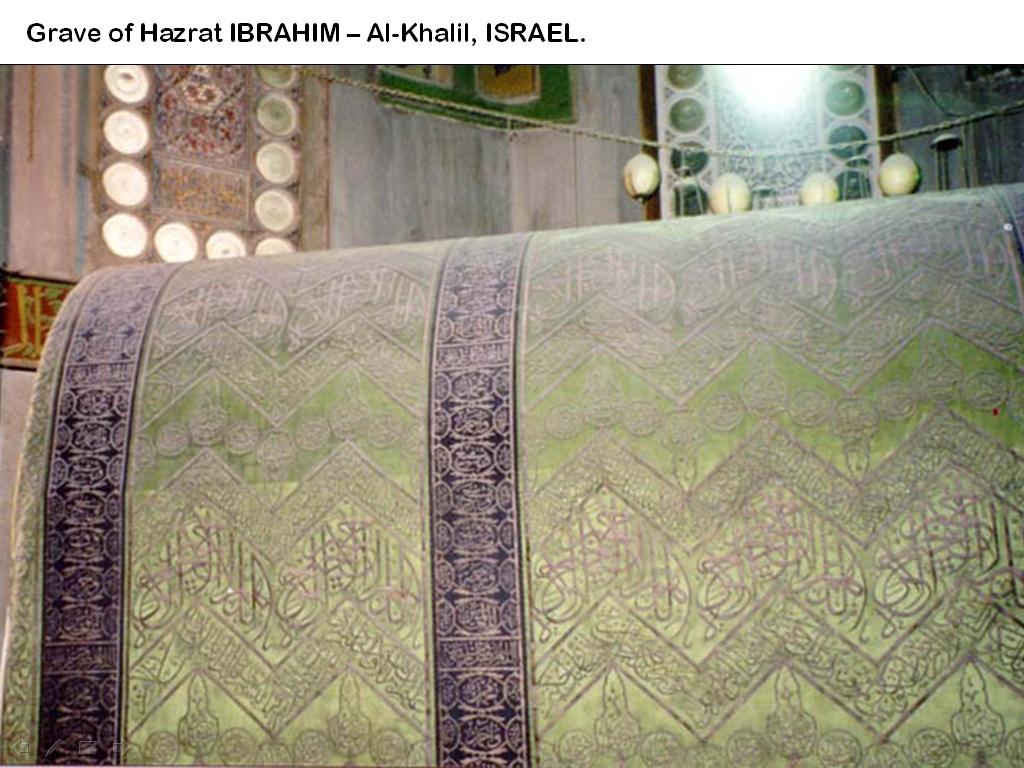
Grave of Hazrat Ibrahim - Al Khalil , Israel
The day when Islam spread out in the Arabian penninsula and its light gradually spread to the vital parts of the Middle East, the graves of the Prophets whose place of burial were known to the people were not only having ceiling and bower at that time but also a dome and place of gathering. Now too a part of their graves stand intact in the same form.

In Mecca itself, the graves of Isma’il (‘a) and his mother Hajar lie on a rock. The grave of Danial (‘a) is at Shush and of Hud (‘a), Salih (‘a), Yunus (‘a) and Dhu’l Kifl (‘a) at Iraq. The graves of the Prophets like Ibrahim (‘a) and his sons Ishaq (‘a), Ya’qub (‘a) and Yusuf (‘a) who were brought from Egypt to Bayt al-Maqdas by Musa (‘a) are in the occupied Quds and all of them possess structure, signs and symbols.

The grave of Hawwa is in Jeddah where the traces of it were destroyed after the conquest of tribe of Sa’uds and the reason this land is called as Jeddah is because of her grave in that place although this relationship may not be correct.

When the Muslims gained control over this place they never got disturbed and never issued any orders for its demolition.

If truly the renovation of graves and burial of the dead in a covered shrine is forbidden in Islam, then the first and foremost task of the Muslims of that time was to destroy all the graves existing in Jordan and Iraq and secondly prevent the restoration of any structure at all times. Not only have they not destroyed these shrines but also during the entire 14 centuries they have strived in protecting and renovating any traces left from the previous Prophets.

By their God-gifted wisdom they took the protection of the remains of the Prophets to be one way of expressing their respect towards them and by this action reckoned themselves to be pious and virtuous.

Ibn Taymiyya in his book al-Sirat al-mustaqim says:

“At the time of victory of al-Quds the graves of Prophets consisted of a constructed structure but its doors were closed till the fourth century hijri” [1]

If truly construction over the graves was a prohibited affair, then its demolition was naturally necessary and its continuity not justified. In short, the existence of these structures duing this period and before the very sight of Islamic scholars is itself an evident sign of its being permissible in the religion of Islam.

Islamic Remnants are the Sign of Originality of Religion [2]
Fundamentally, protecting the remnants of Prophethood especially the traces of Holy Prophet (s) such as his shrine, the graves of his wives, children and companions, the houses in which he lived and the mosques wherein he recited prayers, all have great significance which we shall now discuss.

Today, after the lapse of twenty centuries following the birth of (‘Isa) Jesus Christ (‘a) and his mother (Maryam) Mary (‘a), his book Bible and his companions and disciples, all have been looked upon as a fairy tale in the West. A group of Orientalists have doubted the existence of this heavenly man by the name of Christ whose mother was Mary and his book Bible and described them as a fairy tale like the fairy tale of Layla and Majnun. Why!? Because not even one genuine trace of Jesus Christ is at hand. For example, his true place of birth, his house where he lived in and the place of his burial according to Christian belief are not known. His heavenly book fell victim to distortion and these four gospels where in the last chapter of each of them there is the description of death and burial of Jesus Christ is certainly not related to him and it clearly shows that they have been compiled after his demise. Thus most of the researchers recognise them to be the literary works of the second century A.D. However, if all the specifications related to him had been protected, then there would have been a clear proof and confirmation to his originality and there would have been no excuse for these fictional and skeptical persons.

Muslims openly announce to the world that: “O people! 1400 years ago a man was appointed in the land of Hijaz for the guidance of the human society and he was fully successful in his mission. All the specifications of his life have been protected as seen in his life without the slightest ambiguity and even the house where he was born is known to us. The mount of Hira is a place where revelation (wahy) used to descend upon him and it is in this mosque where he used to pray and this is the house where he was buried in and these are the houses of his wives, children and relatives and these are the graves of his children, wives, Caliphs and….

Now, if we remove all these traces or signs, then obviously we have erased all the traces of his existence and the signs of his originality and prepared the ground for the enemies of Islam. Therefore destroying the traces of Messengership and household of the Prophet is not only one kind of disrespect but also a war against the original manifestations of Islam and authenticity of Messengership of the Prophet (s) .

The constitution of religion of Islam is a permanent and everlasting programme and till the day of Judgement it will remain as the religion of mankind. The generations that will follow after thousands of years have to believe in its authenticity. Therefore, for ensuring this objective, we have to always protect all the traces and signs of the Holy Prophet (s) and in this way take a step in safeguarding the religion for the coming years. We should not do anything that will make the fate of Prophethood of the Holy Prophet (s) meet the same end as that of Prophet (‘Isa) Jesus (‘a).

The Muslims have strived for the protection of the traces of the Holy Prophet (s) to such extent that they have accurately recorded all the specifications of his life during Prophethood, such as the details of his ring, shoes, brush and the signs of his sword, spear, shield, horse, camel and slave. Even the wells from where he used to draw water and drink and the territory which he has bequeathed and still more the style of his walking and eating and the kinds of food which he liked and the appearance of his beard and his way of applying dye, etc, have been recorded and to a certain extent these signs have still remained till today.

By referring to the history of Muslims and touring the expansive Islamic countries, it becomes clear that renovation of graves and their protection and preservation was one of the customs of the Muslims. At present, throughout the Islamic countries, the graves of Divine Prophets, awliya Allah and the pious people exist in the form of shrines and for their protection endowments are available where their revenues are used for their preservation, etc.

Before the birth of faction of Wahhabism at Najd and before their domination over the two holy shrines and the outskirts of Hijaz, the graves of awliya Allah had been erected, thriving and worthy of attention of everyone. None of the Islamic scholars had any objection towards them.

It is not only in Iran where the graves of awliya and virtuous people have been sanctified in the form of shrines but throughout the Islamic countries, especially Egypt, Syria, Iraq, the western countries and Tunisia the shrines of scholars and great personalities of Islam are flourishing and muslims depart in groups towards these shrines to visit their graves and recite fatiha and Holy Quran for the souls of these great personalities. All these holy places are having servants and protectors responsible for maintenance and keeping them clean.

With such propagation and dissemination throughout the Islamic countries, is it possible to regard the rennovation of graves as a forbidden act when this long-drawn custom was existing and still exists from the beginning of Islam till today and this custom is known in the language of the scholars as 'the ways or conduct of Muslims'? The existence of such behaviour without any objection from any corner shows that it is permissible, desirable and popular.

This matter is so fundamental that one of the Wahhabi writers too confesses to it as such:


“This matter has reached the common places, East and the West to such an extent that there is no Islamic country where there is no holy grave or shrine. Even the mosques of the Muslims are not devoid of it and reason does not accept that such an affair remains forbidden and the scholars of Islam have kept silent towards this matter.” [3]

However, inspite of such confession they have not left their obstinacy and say that the prevalence of such matter and the silence of scholars are no reason for it to be permissible. And if a group remains silent due to some reason or the other, another group under different situation will reveal the fact.

But the answer to such talks is obvious since for seven centuries, the scholars of Islam had remained silent and did not utter a word regarding this matter. Were all of them conversative during this period!? Why at the time of the victory over Baitul-Muqqadas the second Caliph did not destroy the traces of graves of the Prophets? Did he too compromise with the polytheists of his time!?

Surprising is the reply of scholars of Medina who say;


“Construction over the graves is forbidden according to the consensus of scholars because of the correct traditions which have come in this regard. Thus a great many of scholars have given their verdict (fatwa) for their destruction.”

How can the claim of consensus be made over prohibition of construction over graves when we see that the Muslims buried the Holy Prophet (s) in the house where his wife - Ayesha - was living. Later Abu Bakr and ‘Umar were buried near the Holy Prophet (s) in the same chamber. Thereafter, the chamber of Ayesha was divided from the middle and a wall was put up there. A portion of it was earmarked for Ayesha and the other portion was related to the grave of the Holy Prophet (s) and the two Caliphs. During the time of Abdulla bin Zubayr, the wall was raised to a higher level due to its low height.

From then on, in every period, the house in which the Holy Prophet (s) was buried was either renovated or reconstructed based on the special architecture of that time. Even during the period of the caliphate of the Umayyads and Abbasids the matter of construction of grave was in vogue and graves were constructed in every period with the special architecture of that time.

And the last of the construction over the grave which still exists was the construction of Sultan Abdul Hamid which started in the year 1270 and lasted for four years. You can read the detailed history of rennovation and reconstruction of the house of the Holy Prophet (s) throughout the Islamic history till the time of Samhudi in the book Wafa -ul- Wafa of Samhudi [4] and some other related books about the history of Medina. 

Notes : 

 [1] Sayyid Muhsin Amin, Kashf al-‘irtiyab, p. 384.
[2] Refer to the Tabaqat al-sahaba in Ibn Sa’d, al-Tabaqat al-kubra, vol.1 pp. 360 to 503. In these pages we find the specialities and characteristics of the life of the Prophet (s).
[3] Tathir al-‘i’tiqad, (Egyptian edition), p. 17, narrating from Kashf al-‘irtiyab.

[4] al-Samhudi, Wafa’ al-wafa’ fi akhbar dar al-Mustafa, pp. 383 to 390.

Qur’anic View-Point Regarding Renovation of Grave

 
Graves of Grandsons of Prophet (s.a.w.a)

The Qur’an has not directly passed a judgement about this matter but it is possible to derive its ruling from some of the relevant verses. The details follow.

1- Renovating and protecting the graves of the Prophets is nothing but paying respect to the Divine Rites.

The Holy Qur’an reckons the respect of Divine rites to be a sign of piety and purity of heart. 
It says:


“And whoever respects the signs of Allah, this surely is (the outcome) of the piety of hearts”. (Hajj: 32)

What is meant by respect of Divine rites?  is the plural of  and gives the meaning of sign and symbol. This verse does not show the sign of existence of God since the whole Universe is the sign of His existence. And nobody has said that respecting whatever things that exist in this Universe is the sign of piety. Instead, it shows the signs of His religion and thus the exegetes interpret this verse as “the Signs of religion of Allah”. [1]

If in the Qur’an, Safa and Marwa [2] and the camel which is to be sacrificed in Mina [3] are reckoned to be the rites of God it is for the reason that these are the signs of straight religion (Din-e-Hanif) and beliefs of Ibrahim. If Muzdalifa is considered to be al-mash’ar, it is because it is the sign of religion of God and stopping at this sign (during Haj) is practically acting on the religion and obedience to God.

If the entire Hajj rites are named as al-sha’air it is because these actions are the signs of divine and true religion.

In short, whatever are the signs and symbols of divine religion, respecting them is the source of nearness towards God. Indisputably, the Prophets and Awliya Allah who were the channel for propagating religion among the people are the greatest and the most evident signs of the divine religion. No just person can deny this fact that the existence of the Holy Prophet (s) and Imams (‘a) are from the proofs of Islam and are the signs of this holy religion and one of the ways of respecting them is protecting their graves and their remains and safeguarding them from any kind of destruction.

Anyhow, the matter of respect for the graves of awliya Allah (friends of God) becomes clear when we consider two things:

(a) The Prophets and awliya Allah, in particular those who have sacrificed their lives in the path of religion are from the divine sha’air (rites) and signs of religion.

(b) One of the ways of respecting this group after their demise is to safeguard and renovate their graves as well as protecting their school of thought. For this reason throughout the world, great religious and political leaders whose graves are a symbol of their school of thought are buried in such selected places which remain permanently safe. Safeguarding their grave from destruction is the sign of protection of their existence and eventually the sign of protection of their school of thought.

For understanding this fact it is necessary to examine and analyse accurately verse number 36 of Sura Hajj. Some of the pilgrims to the House of God take a camel along with themselves right from their houses to be sacrificed near the House of God. They earmark on this camel for sacrifice in the way of God and distinguish it from the other camels by putting a collar round its neck. As this camel is somehow related to God then according to the same verse it is considered to be the sha’air (rites) of God and according to the contents of verse 32 of Sura Hajj  should be respected. For example, no one should ride on that camel and water and grass should be given to her at the appropriate time till the time she is slaughtered.

When one camel which is earmarked for being sacrificed near the House of God is considered to be a part of sha’air (rites) and its honour and respect is found to be necessary, then why the Prophets, Imams, Scholars, Martyrs and those who right from the beginning of their life have put the collar of obedience and submission to God around their neck and have become a channel between God and His creatures are not to be considered a part of sha’air (rites) of God and their respect and honour not necessary? If really Ka’ba, Safa, Marwa, Mina and Arafat, which are all inanimate objects and no more than stone and mud, are part of the sha’air (rites) because of being related to the divine religion and each one requires obligatory honour and respect, then why the Divine Leaders, who are the preachers and protectors of the divine religion, and those things which are related to them not part of the sha’air (rites)!? [4]

We put the conscience of Wahhabis to justice in this matter. Do they doubt the Prophets and Messengers to be amongst the sha’air (rites) of Allah and do not they consider the protection of their traces and things related to them as honourable!? Does respect and honour mean renovating their graves and keeping them clean or rather destroying and turning them into a heap of ruins?

2- The Holy Qur’an very clearly instructs us to love the near ones of the Holy Prophet.

The Qur’an says:
                                                                                 
                                                                                                                                            
“Say; I do not ask of you any reward for it but love for my near relatives.” (Shura: 23)

From the view point of the general people who are referred to by this verse, is not the matter of the grave and its renovation as one of the ways of expressing love towards the household of the Holy Prophet (s)? We see that this custom was and is still prevailing amongst all the nations and they think this to be one way of expressing their love to the people in grave. Thus great political and religious personalities have been buried in the church or in famous shrines surrounded by flowers and trees.

3. Renovation of grave and the past generation

From the Qur’anic verses we come to know that respect towards the grave of a believer was one kind of practise which was in vogue amongst the nations prior to Islam.

About the companions of Kahf, Qur’an narrates that when their condition became known to the people of that time and they came near the entrance of the cave, they expressed two views about their graves
                                                                                                                                                                                                                                                                      
“…..Erect an edifice over them….,” (Kahf: 21)


“….Those who prevailed in their affair said: We will certainly raise a mosque over them”….. (Kahf: 21)


The Qur’an narrates these two views without any criticism. Of course it can be said that if either of these two views were wrong then surely Qur’an would have criticised them or would have narrated their action with condemnation. Anyhow these two views show that one of the ways of respect of the awliya Allah and virtuous people has been the protection of their shrines.

By paying attention to these three verses we can never declare the matter of renovation of graves of the awliya Allah, Prophets and the virtuous ones as prohibited and or an abominable affair. Instead we can interpret it to be one kind of respect to the sha’air (rites) of God and manifestation of mawadda fi al-qurba (love towards kinsfolk).

4. Elevation of Special Houses

The Qur’an sets forth one novel parable wherein the Light (nur) of Allah is compared to a lamp which is having a light within it, and this elegant and profound parable begins with the sentence  and ends with the sentence.

After setting forth this parable which itself is having a lengthy discussion, Qur’an says:


“In houses which Allah has permitted to be exalted and that His name may be remembered in them; there, glorify Him therein in the mornings and the evenings, Men whom neither trade nor selling diverts from the remembrance of Allah”. (Nur: 36 & 37)

Argumentation of this verse requires, before anything else, two points to be clarified:
(a) What is meant by  (houses)?
(b) What is meant by  which has come in the meaning of raising and elevation?

Regarding the first word, we have to remind you that its objective is not limited to mosques. Instead it refers to mosques and houses such as the houses of Prophets and awliya Allah which possesses the aforesaid specialities mentioned in the verse and there is no reason to confine the meaning of the word to mosque. The whole of this  most common being the mosques and houses of the Prophets and the pious ones who have never been forgetful of the Hereafer, is the centre of Light (nur) of Allah and the flames of tawhid, purification and glorification. Instead it can be said that  here excludes the mosques because a house consists of four walls and surely a ceiling and if Ka’ba is called as  (house of Allah) it is because it possesses a ceiling. But we see that it is recommended (mustahab) that a mosque should be devoid of a ceiling and at present even Masjid al-Haram is without a ceiling. The verses of the Qur’an too show that by house is meant a place possessing a ceiling. It says:
               
               
“And were it not that all people had been a single nation, We would certainly have assigned to those who disbelieve in the Beneficient God (to make) of silver the roofs of their houses.” (Zukhruf: 33)
Anyhow  either refers to a place other than mosque or it consists of both mosque and house.
Now it is time to explain the meaning of the second word i.e.

The word  in the Arabic language means 'to raise' or 'to elevate' and the verse explicitly says that God has permitted these houses to be elevated. This elevation either refers to physical elevation i.e. raising the base and the walls and protecting them from tumbling down as Qur’an has used the same meaning in the following verse, 
                                                                                     

“And when Ibrahim and Ismail raised the foundations of the House” (Baqarah: 127)

or it refers to spiritual elevation i.e. God has given a special privilege to such houses and has raised their rank and position.

If we take the meaning of physical elevation, then it clearly shows that the houses of the Prophets and awliya Allah who are the true proofs of these houses, are worthy of renovation - whether during their lifetime or after their demise, whether they are buried there itself (like the house of the Holy Prophet (s), Imam al-Hadi and Imam al-‘Askari where their houses are their graves because they were buried in their own houses) or in some other place. Under any condition such houses are to be renovated and protected from ruin and destruction.

And if we take the meaning of spiritual elevation, then we conclude that God has permitted such houses to be honoured and respected and one of the ways of manifesting our respect to such houses is safeguarding them from destruction and renovating them and keeping them clean.

All these physical and spiritual elevation is because these houses belong to the divine men who were God's obedient servants and were submissive to His commands.

Despite these and such other verses it is a matter of shock as to how the Wahhabis have destroyed the traces of Messengership and ruined their houses and have turned into a heap of rubble, these lustrous places where men and women used to glorify and praise God, day and night, and gather in these places and recite supplications because of the spiritnal connection the owners of these houses had with God! This shows as to how they have openly and apparently disclosed their old enmity with the Holy Prophet (s) and his household (‘a) and his sincere companions!

In this connection we draw the attention of our readers to one tradition.

Anas bin Malik says: The Holy Prophet (s) recited this verse. At that time a person stood up and said:


refers to which house?

The Holy Prophet (s) said – “The house of the Prophets”.

Abu Bakr stood and said –“Is this house (refering to the house of ‘Ali and Fatima) included amongst them?

The Holy Prophet (s) replied  [5]

“Yes, it is the most important of all of them.” 

Notes : 
[1] al-Tabarsi, Majma’ al-bayan, (Sayda edition), vol. 4 p. 83.

[2] Baqarah: 158

[3] Hajj: 36

[4] Protection of graves is expression of love and affection.

[5] al-Suyuti, al-Durr al-Manthur, vol. 5 p. 50.

Wahhabis and the Renovation of Graves of Awliya Allah


Amongst the matters about which the Wahhabis are most sensitive is the matter of renovation of graves and construction over the graves of Prophets, Imams and the pious ones.

This matter was at first initiated by Ibn Taymiyya and his famous student Ibn al-Qayyim and they gave their verdicts (fatawa) in prohibiting the construction of a structure and the necessity of its destruction.

 Ibn al-Qayyim in his book Zad al-ma’ad fi huda khayr al-‘ibad [1] says as such:


It is obligatory to destroy the structure constructed over the grave and after gaining power for their destruction it is not permissible to reinstate them even for one day.
 [1] Ibn al-Qayyim, Zad al-ma’ad fi huda khayr al-‘ibad, page 661. 
In the year 1344 AH when the Sa’uds had gained control over Mecca, Medina and its surroundings, they planned a pretext for destroying the graves of Baqi’ and the traces of household and companions of the Holy Prophet (s). By getting verdict (fatwa) from the scholars of Medina they wanted to pave the way for demolition and preparing the minds of the people of Hijaz who were never in favour of such action. For this reason they sent the Chief Judge of Najd, Sulayman bin Bulayhid towards Medina for the purpose of deriving benefit from the scholars of that place regarding this matter. Thus he planned the questions in such a manner that its answers (as per the viewpoint of the Wahhabis) were hidden in the questions itself. And in this way he declared to the muftis that their replies should match the answers which had come in the questions; otherwise they would be called as polytheists and be killed if they would not repent.

The questions and answers were published in the newspaper Umm al-Qura in Mecca in the month of Shawwal 1344 AH. [2] As a result of this publication, a severe reaction took place among the Muslims mainly Sunnis and Shi’as because they were aware that after taking the verdict (fatwa) even if it was by way of force, the destruction of graves of the leaders of Islam would commence.Incidentally, after taking the verdict from fifteen scholars of Medina and publishing it in Hijaz, the destruction of the traces of the household of the Prophet (s) began on the 8th of Shawwal of the same year. The entire traces of Ahl al-Bayt (‘a) and the companions of the Holy Prophet (s) disappeared and the valuable properties of the shrine of the Holy Imams (‘a) at Baqi’ were plundered and the graveyard of Baqi’ was turned into a heap of dung which would fill one with horror while looking at it.

 Now we will mention some of the questions so that it becomes clear as to how the answers had been placed in the question itself. That is to say, the aim was not to ask any questions but gain a pretext for destroying the traces of Messengership. If the aim was truly conception and realism it was meaningless for the inquirer to place the answers in the questions itself. Instead we can deduce from it that the questions and answers were written on a piece of paper which they took to the scholars (ulama) of Medina only for getting their signature since it is un-imaginable that the famous scholars of Medina who for years were propagators and protecters of the traces of the Holy Prophet (s) and the visitors to his grave would, all of a sudden, accept the views of others and give their verdict for the prohibition of construction and the necessity of its destruction.
Sulayman bin Bulayhid says in his questions:


1. What are the views of the scholars of Medina who, may God increase their knowledge and insight, about construction over the graves and setting them as mosques? Is it permissible or not? And if it is not permissible and is strictly prohibited in Islam, then is it necessary and compulsory to destroy them and prevent the people from reciting prayers near it or not?

2. If in one endowed (waqf) land like Baqi’ construction over the grave becomes an obstacle from making use of those sections which are over that, then is this act not usurption of a portion of the waqf?


The scholars of Medina under threat and compulsion gave replies to the questions of Shaykh as follows:

Construction over the graves is forbidden. Based on some traditions proving its prohibition, a group have given verdict (fatwa) for the destruction of the same. In this matter they have made use of the tradition which Abu al-Hayyaj has narrated from ‘Ali (r). The latter told him - I am entrusting you with a work which the Messenger of God (s) had entrusted me with the same. Don't see any picture but that you erase it and don't see any grave but that you level it.

Shaykh Najdi in an article, which was published in the newspaper Umm al-Qura No. Jamadi al-thani 1345 AH, says:

Construction of dome and structure was in vogue from 5th century AH.

These are a few examples of the sayings of Wahhabis about renovation of graves and mostly they put forth two reasons in support of their sayings:

1. Consensus of the scholars of Islam about its being prohibited.

2. Tradition of Abu al-Hayyaj from Ali (‘a) and some other similar ones.

It should be known that our discussion at present is about renovation of graves and construction of bower or ceiling over them. However the matter of ziyarat - visitation to graves - will be discussed separately.

For making the matter clear, we will discuss this issue from three perspectives:

1. What is the view of the Qur’an regarding this matter? Can we derive the judgement from the Qur’an?

2. Does the Islamic ummah in reality have consensus in its being prohibited or is it that in all the Islamic ages the matter was something else and renovation of graves and construction of house was in vogue during the period of the Holy Prophet (s) himself and his companions?

3. What is the derivation of the tradition of Abu al-Hayyaj, Jabir, Umm Salama and Na’im which the Wahhabis utilise?


Please Read our Answers : Qur’anic View-Point Regarding Renovation of Grave


Familiarity with the Life of the Founder of Wahhabism


Wahhabism is ascribed unto Shaykh Muhammad, the son of ’Abd al-Wahhab of Najd. This ascription has been derived from the name of his father ’Abd al-Wahhab. And as some scholars put it, the reason why this creed has not been attributed to Shaykh Muhammad himself and has not been called Muhammadiyyah is for fear lest the followers of this creed would find a kind of association with the name of the Holy Prophet (s) [1] and would misuse this ascription. Shaykh Muhammad was born in 1115 A.H.  in the city of ‘Uyayna which was located in Najd. His father was a judge in this city. Ever since his childhood, Shaykh Muhammad had a great liking for the study of books on tafsir (Qur’anic interpretation), hadith (tradition), and aqa’id (principles of beliefs). He learned the Hanbali jurisprudence from his father who was one of the Hanbali scholars. From the bloom of youth, he regarded as indecent many of the religious doings of the people of Najd. After going on a pilgrimage to the house of Allah and performing its rites, he headed for Medina where he rejected the resorting of the people to the Holy Prophet (s) near his shrine. He then returned to Najd, and from there he went to Basrah with the aim of later leaving Basrah for Damascus.He spent some time in Basrah and embarked on opposing many doings of the people. The people of Basrah, however, cast him out of their city. While on his way from Basrah to the city of al-Zubayr, he was about to perish due to the intensity of the heat, thirst, and toll of walking in the desert. But a man from al-Zubayr, seeing the Shaykh clad like the clergy, endeavoured to save him. He gave the Shaykh a gulp of water, set him on a mount, and took him to the city of al-Zubayr. The Shaykh wanted to travel from al-Zubayr to Damascus, but as he did not have sufficient provisions and could not afford the expenses of the journey, he changed his destination and headed for the city of al-‘Ahsa. From there, he decided to go to Huraymala, one of the cities of Najd.

At this time which was the year 1139 AH, his father ’Abd al-Wahhab had been transferred from ‘Uyayna to Huraymala. Shaykh Muhammad accompanied his father and learned (the material in) some books from his father. He set out on rejecting the beliefs of the people of Najd. For this reason, altercation and debates ensued between him and his father. In like manner, serious and violent disputes erupted between him and the people of Najd. This matter lasted several years until his father Shaykh ‘Abd al-Wahhab passed away in the year 1153. [2]

After the demise of his father, Shaykh Muhammad embarked on expressing his own beliefs and rejecting part of the religious acts of the people. A group of the people of Huraymala followed him and his work won fame. He departed from Huraymala for the city of ‘Uyayna. At that time, ‘Uthman ibn Hamd was the head of ‘Uyayna. ‘Uthman received the Shaykh, honoured him and made the decision to assist him. In return, Shaykh Muhammad also expressed hope that all the people of Najd would obey ‘Uthman ibn Hamd. The news of Shaykh Muhammad's call and doings reached the ruler of al-‘Ahsa. He wrote a letter to ‘Uthman. The consequence of this letter was that ‘Uthman summoned the Shaykh and dismissed him. Shaykh Muhammad replied that if you help me, you will become the leader of the entire Najd. ‘Uthman, however, avoided him and cast him out of the city of ‘Uyayna.


Aye Jannatul Baqiya - Marsiya by Shaheed Ustad Sibte Jafar


Very nice kalaam written by Shayar-e-Ahlebait Sibt-e-Jaffer for Jannat-ul-Baqi. May Allah enable us to see the shrines of Jannat-ul-Baqi and Jannat-ul-Mala rebuilt (Ameen) 

A Short Documentary of Jannatul Baqi and its Destruction by Aale Saud - Video


A short documentary about the situation of Jannat ul Baqi and destruction of other Holy Places in Madina and role of Al Saud.
Related Posts Plugin for WordPress, Blogger...